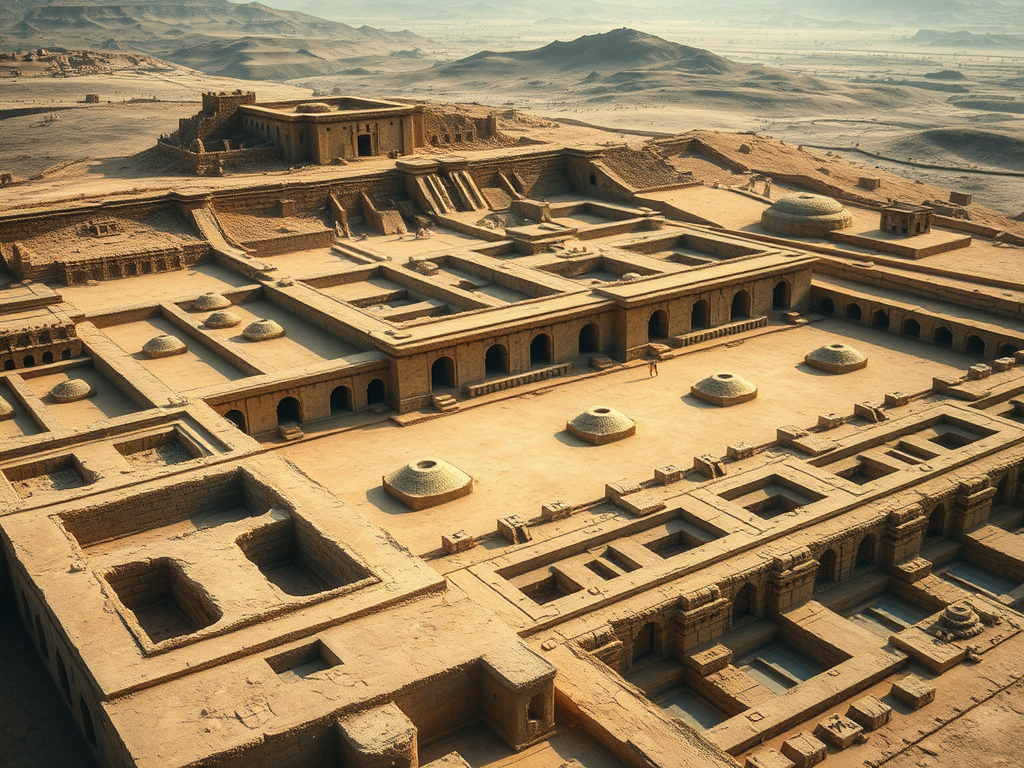
Introduction to the Indus Valley Civilization

55,836 views

Introduction to the Indus Valley Civilization • CrackTarget
2600 — 1900 BCE • MATURE HARAPPAN PHASE

THE INDUS VALLEY
CIVILIZATION

The world’s first truly planned urban civilization.
Advanced drainage. Standardized bricks. Maritime trade.
Undeciphered script. Timeless legacy.

1.5 MILLION SQ KM
1400+ SITES
𐤇𐤀𐤓𐤀𐤐𐤐𐤀
— THE UNICORN SEAL —
MOST COMMON SEAL MOTIF • STEATITE
From Sutkagen Dor to Alamgirpur
Grid planning • Standardized bricks (4:2:1)
Advanced covered drainage & 700+ wells
Maritime trade with Mesopotamia (Meluhha)
EXCAVATED • RECONSTRUCTED

City Structure Maps

Each major Harappan settlement followed a remarkably consistent yet locally adapted urban blueprint.

MOHENJO-DARO
Sindh, Pakistan • “Mound of the Dead”
CITADEL (WEST)
THE GREAT BATH
12×7m • Waterproofed • Ritual bathing?
Granary
6 rows × 2
LOWER TOWN (EAST)
House
House
Courtyard
House
Well
Workshop
House
House
House
Drain
Grid streets • Private wells • Covered drains
~300 hectares • Population ~40,000

Mohenjo-daro

The most spectacular and best-preserved city of the Indus Valley. Discovered in 1922 by R.D. Banerjee.

The Great Bath — Sophisticated waterproofing with bitumen. Likely used for ritual or public bathing. Steps on both sides.
700+ wells — Every third house had a private well. Extraordinary water management.
Dancing Girl (bronze) & Priest-King (steatite bust) discovered here.
UNESCO Tentative List
Advanced Civic Planning
DHOLAVIRA
Gujarat, India • UNESCO World Heritage (2021)
CITADEL
Administrative & elite quarter • Large reservoirs nearby
MIDDLE TOWN
Residential + craft workshops
LOWER TOWN
RESERVOIR
RESERVOIR
RESERVOIR
RESERVOIR
16+ rock-cut reservoirs • Sophisticated water conservation
Unique 3-part division

Dholavira

The most spectacular water management system of the ancient world. Located in the arid Rann of Kutch.

KEY INNOVATION
World’s earliest known water reservoirs system with channels, dams and stepwells integrated into urban planning.
Famous signboard with 10 large Indus script characters (oldest signboard?)
Three distinct zones separated by massive walls
Stone architecture dominant (unlike baked brick elsewhere)
LOTHAL
Gujarat • Ancient Port City
DOCKYARD
World’s earliest known artificial dock • Tidal lock system
WAREHOUSE
Bead making factory • Shell & carnelian workshops
Lower Town — Grid streets, houses, drainage
Trade with Persian Gulf & Mesopotamia
Lothal was the maritime gateway. The dock (214×36m) could accommodate ships of 20-30 tons. Evidence of bead-making industry on industrial scale.
HARAPPA
Punjab, Pakistan • The Type Site
CITADEL
GRANARIES
Two rows of 6 granaries each • Massive storage capacity
LOWER TOWN
House blocks
Streets
Cemetery H
Cemetery H culture marks Late Harappan phase
First site discovered (1826)
Harappa gave the civilization its name. Famous for its massive granaries and the transition from Early to Mature phase. Cemetery H shows cultural shift in Late Harappan period.

Core Features of Harappan Urbanism

Grid Pattern Streets

Main streets ran North-South and East-West, intersecting at right angles. Main roads ~9-10m wide. Houses opened onto lanes, not main streets — remarkable civic discipline.

Covered Drainage

Every house connected to street drains via terracotta pipes. Drains had inspection holes and soak pits. One of the most advanced sanitation systems of the ancient world.

Standardized Bricks

Uniform ratio of 1:2:4 (thickness : width : length) across the civilization. Baked bricks used even in foundations. Shows strong central authority or shared technical knowledge.

Weights & Measures

Standardized cubical stone weights following a binary system (1, 2, 4, 8, 16, 32, 64). Used for trade across vast distances. Precision craftsmanship.

Long-Distance Trade

Evidence of trade with Mesopotamia (Meluhha), Oman, Iran, Afghanistan and Central Asia. Carnelian beads, cotton textiles, timber, ivory exported. Lothal and Dholavira were key ports.

Undeciphered Script

Over 400 distinct signs. Short inscriptions (average 5 characters). Found mostly on seals and pottery. Direction mostly right to left. Still one of archaeology’s greatest mysteries.

Sources for Reconstruction

Primary: Archaeological Sources
Structures, artifacts, seals, pottery, burials, tools. Since the script remains undeciphered, material remains are our only direct evidence.
Limited Literary Sources
Rigveda references (possibly “Hariyupiya” near Ravi river). Mesopotamian texts mention “Meluhha”. No contemporary indigenous texts.
Integration challenge: Archaeology gives us the “what”. Literary sources (later) give possible context but require careful corroboration.

The Decline

Gradual process between 1900–1300 BCE. No single catastrophic event.

Shift in river courses (Ghaggar-Hakra / Sarasvati)
Climate change & aridification
Decline in long-distance trade
Possible over-exploitation & salinization
Internal socio-political factors
Aryan Invasion theory has been discarded by modern scholarship. Evidence points to peaceful de-urbanization and cultural transformation.
FOR UPSC • BPSC • EPFO • DRDO

Key Points for Quick Revision

Phases
Early (3300–2600 BCE) → Mature (2600–1900 BCE) → Late (1900–1300 BCE)
Major Sites
Mohenjo-daro, Harappa, Dholavira, Lothal, Kalibangan, Rakhigarhi, Chanhudaro
Town Planning
Grid pattern, Citadel + Lower Town, covered drains, standardized bricks, wells
Economy
Agriculture (wheat, barley, cotton), craft specialization, long-distance trade (Meluhha)
Decline Theories
River shift, climate change, trade collapse, internal factors (NOT Aryan invasion)
UPSC Focus
Compare town planning with contemporary civilizations. Significance of Great Bath & Dockyard. Why script remains undeciphered.
Crafted for aspirants • CrackTarget.com • Pure Harappan aesthetic edition
Back to CrackTarget

Discover more from CrackTarget

Subscribe to get the latest posts sent to your email.


Comments

Leave a comment

Discover more from CrackTarget

Subscribe now to keep reading and get access to the full archive.

Continue reading

Discover more from CrackTarget

Subscribe now to keep reading and get access to the full archive.

Continue reading