

CrackTarget / History Learning Hub
Medieval Indian History
Structured notes, important dynasties, administration, art and culture, chronological revision, practice MCQs and topic-wise articles for UPSC, BPSC and State PSC examinations.
Understanding Medieval Indian History
Medieval Indian history is not the story of one dynasty replacing another. It is a long record of changing political institutions, agriculture, trade, urban life, languages, faiths and artistic styles across the subcontinent. For competitive examinations, a useful working range is approximately the eighth to the eighteenth century, although textbooks and historians may draw the beginning and end differently. The chronology overlaps with what specialists sometimes describe as the early-modern period, especially in the sixteenth to eighteenth centuries.
Political authority during these centuries was distributed among regional kingdoms, sultanates, large empires, local chiefs, temple institutions and commercial communities. Some rulers attempted to build extensive territorial states; others depended on networks of alliances, tribute and military service. Changes were uneven: developments in the Ganga plain did not always coincide with those in the Deccan, Bengal, Rajasthan, Kashmir or the far south. That regional diversity is essential for avoiding overgeneralised examination answers.
This page works as both a complete revision overview and a topic-wise directory of CrackTarget articles. Read the period overview first, follow the linked modules for greater depth, then attempt the questions and revise the chronological table. UPSC Civil Services, BPSC, State PSC, SSC and other general-studies examinations commonly require factual chronology together with an understanding of institutions, society and cultural interaction.
Sources and How Historians Reconstruct the Period
Medieval Indian history is reconstructed from inscriptions, copper-plate grants, coins, manuscripts, chronicles, biographies, architectural remains, inscriptions on buildings and the accounts of travellers. No single source offers a complete or neutral picture. A royal inscription may emphasise victories and generosity, while a court chronicle can reflect the interests of its patron. Historians compare such evidence with material remains and other contemporary texts.
Persian chronicles and administrative writings became particularly important for several Sultanate and Mughal courts. Tabaqat-i Nasiri by Minhaj-i Siraj and writings of Ziyauddin Barani help in studying the Delhi Sultanate. The Baburnama offers Babur’s autobiographical account; Abu’l Fazl’s Akbarnama and Ain-i Akbari are major sources on Akbar’s reign and state organisation. These works must be read critically because proximity to rulers can shape their emphases.
Travel accounts add outside perspectives. Al-Biruni wrote on Indian learning and society in the eleventh century, Ibn Battuta described fourteenth-century India, and travellers such as Domingo Paes and Fernão Nunes are associated with Vijayanagara. Their observations are valuable but selective. For prelims, connect author, text, period and ruler; for descriptive answers, explain what kinds of evidence each source can and cannot establish.
Early Medieval Kingdoms and Regional Power
Between roughly 750 and 1200 CE, numerous regional kingdoms exercised power over parts of the subcontinent. The Gurjara-Pratiharas, Palas and Rashtrakutas contested influence over northern India and the prestigious centre at Kannauj. This is often called the tripartite struggle, but it should not be reduced to a single uninterrupted battle. Political fortunes and territorial control shifted over generations, and local rulers continued to matter.
In the Deccan and south, the Chalukyas, Rashtrakutas, Pallavas and Cholas left important administrative, religious and architectural legacies. The Chola state under Rajaraja I and Rajendra I is especially significant for its military activity, maritime contacts, temple patronage and inscriptions recording local institutions. The Brihadisvara Temple at Thanjavur is associated with Rajaraja I. Village assemblies in parts of the Chola country are known through detailed epigraphic records, including those from Uttaramerur; they should not be mistaken for modern universal democratic institutions.
Land grants to Brahmanas, temples and officials affected control over resources and the organisation of rural society. Irrigation tanks and river systems helped agricultural expansion, while market towns and ports linked cultivators and artisans to wider exchange networks. The terms samanta, brahmadeya, devadana and ur are useful revision points, but their application varied by region and time. Treat early medieval India as a period of institutional development rather than simply political fragmentation.
Delhi Sultanate: Dynasties, Expansion and Administration
The Delhi Sultanate is conventionally dated from 1206 to 1526 CE. Its five principal ruling dynasties were the Mamluk or Slave, Khalji, Tughlaq, Sayyid and Lodi. Qutb-ud-din Aibak established an independent ruling line after the death of Muhammad Ghori in 1206. Iltutmish strengthened the Sultanate’s institutions, while Raziyya’s reign illustrates the powerful role and resistance of Turkish nobles. Balban is associated with efforts to reinforce monarchical authority.
Under Alauddin Khalji, campaigns extended Delhi’s influence into western and southern India. His measures included military reorganisation, market supervision and revenue demands intended to strengthen state resources. Muhammad bin Tughlaq is remembered for ambitious policies concerning the capital, coinage and taxation; evaluating them requires attention to administrative capacity, implementation and contemporary testimony rather than treating each policy as a simple curiosity. Firuz Shah Tughlaq promoted public works and canals alongside other policies characteristic of his reign.
An iqta generally assigned the right to collect revenue from a territory to an official or military commander, subject to the arrangements and controls of the state; it was not automatically absolute private ownership of the land. Important offices included the wazir and departments dealing with finance, military affairs and correspondence. Persian functioned prominently in court administration, while regional languages continued to develop. Mongol pressure, regional rebellions, succession disputes and expanding provincial centres all shaped the limits of central control.
For examination revision, distinguish Sultanate institutions from those of the later Mughals. The Lodis were an Afghan dynasty, and Ibrahim Lodi’s defeat by Babur at the First Battle of Panipat in 1526 conventionally marks the end of the Delhi Sultanate. Study the succession of dynasties, key rulers, revenue institutions and architectural developments as one connected topic.
Vijayanagara, Bahmani and the Deccan
The Vijayanagara kingdom was founded in 1336, traditionally associated with Harihara and Bukka. Its rulers developed a powerful state in south India, with the city of Vijayanagara at present-day Hampi serving as a celebrated imperial centre. Four principal ruling lines are commonly identified: Sangama, Saluva, Tuluva and Aravidu. Krishnadevaraya of the Tuluva dynasty, who ruled in the early sixteenth century, is particularly associated with military campaigns, literary patronage and monumental temple building.
Revenue from agriculture, military service arrangements, control of strategic routes and commerce contributed to the kingdom’s strength. The amara-nayaka system linked powerful military chiefs with the assignment of resources and obligations, although its workings were not identical across the empire. Hampi’s bazaars, ceremonial spaces, waterworks and temples demonstrate the interaction of royal authority, economic activity and sacred geography. Its surviving monuments are recognised by UNESCO as a World Heritage Site.
In the Deccan, the Bahmani Sultanate emerged in 1347 and later fragmented into successor sultanates. The rivalries and alliances between Vijayanagara and Deccan powers involved territory, trade, forts and control of the Krishna–Tungabhadra region; they cannot be understood only as religious conflict. In the Battle of Talikota (1565), a coalition of Deccan sultanates defeated Vijayanagara’s forces, and the capital suffered devastating destruction. The kingdom’s ruling institutions nevertheless continued elsewhere for decades, so Talikota should not be described as an instantaneous end to every Vijayanagara political authority.
Mughal Empire: Rulers, Mansabdari and Revenue
Babur founded Mughal rule in northern India after defeating Ibrahim Lodi in 1526. The victory at Khanwa in 1527 was another major step in his consolidation. Humayun later lost control to the Sur rulers, whose most prominent figure, Sher Shah Suri, is noted for administrative and road-building initiatives. Humayun recovered Delhi in 1555, and Akbar succeeded him in 1556. These events show that Mughal expansion was neither immediate nor uninterrupted.
Akbar developed a durable imperial administration, expanded territorial control and cultivated alliances with important regional elites. The mansabdari system ranked imperial servants and linked status, pay and military responsibilities. Zat indicated personal rank and sawar related to cavalry obligations. A jagir was a revenue assignment frequently used to remunerate nobles, whereas khalisa income was reserved for the imperial treasury. These terms are related but should not be used interchangeably.
Revenue administration drew on measurement, classifications and estimates of cultivation and produce, with important reforms associated with Raja Todar Mal during Akbar’s rule. The zabt system and the dahsala assessment are frequent examination topics. Remember that methods varied considerably by region; there was no single uniform arrangement operating identically throughout the empire.
Akbar’s court also promoted historical writing, translation and religious discussion. His policy of sulh-i kul is commonly discussed as an ideal of universal peace or tolerance in governance. Under Jahangir and Shah Jahan, imperial court culture, painting and architecture flourished. Aurangzeb’s long reign saw extensive Deccan warfare and strains on military and fiscal resources. After 1707, competing regional powers and internal difficulties weakened central Mughal authority, although the dynasty formally continued for much longer.
Marathas, Sikhs and Eighteenth-Century Political Change
Shivaji built a powerful Maratha state in the seventeenth-century western Deccan and was crowned in 1674. Forts, mobile campaigning, local revenue systems and alliances supported Maratha power. His administration is often described through a council of eight ministers, the ashtapradhan, but responsibilities and actual influence changed with circumstances. Terms such as chauth and sardeshmukhi require attention to their fiscal and political context rather than being treated as interchangeable taxes.
In the eighteenth century, the Peshwas became central to a wider Maratha confederate order. Maratha influence expanded far beyond Maharashtra, while major houses including the Scindias, Holkars, Gaekwads and Bhonsles exercised substantial regional authority. The Third Battle of Panipat in 1761 was a serious setback but did not immediately eliminate Maratha political power. For this late period, it is more precise to speak of overlapping Mughal, regional and emerging colonial formations.
The Sikh tradition begins with Guru Nanak in the late fifteenth and early sixteenth centuries. Guru Gobind Singh instituted the Khalsa in 1699; the later rise of Sikh misls belongs chiefly to the eighteenth century. Maharaja Ranjit Singh consolidated a powerful Sikh kingdom around Lahore in the nineteenth-century opening decades. That Sikh Empire is included here as a historical continuation of developments begun earlier, not as a polity confined strictly to the conventional medieval period.
Agriculture, Towns, Commerce and Social Life
Agriculture sustained most medieval states. Expansion of cultivation, irrigation works, land clearance and patterns of taxation shaped relationships among rulers, village communities, intermediaries and cultivators. Agrarian society was differentiated: some communities held substantial local power, while labourers and marginal cultivators had much less bargaining strength. Revenue demands, climatic variability and conflict could have sharply different consequences in different regions.
Trade networks linked inland towns to ports on both coasts and to merchants across the Indian Ocean. Textiles, spices, horses, precious goods and everyday commodities moved through these networks. Gujarati ports, the Malabar coast, Bengal and Coromandel centres participated in extensive commerce. Traders, craft specialists, merchant associations and money handlers played important roles, as did transport and market infrastructure. Medieval economic life included prosperous urban centres without implying that all towns or groups enjoyed the same prosperity.
Social identities involved caste, occupational groups, lineage, regional community, religion and status. Women appeared as rulers, poets, patrons, workers and participants in devotional traditions, although opportunities were structured by prevailing inequalities. Learning also took place through households, religious institutions, courts and specialist traditions. Historians examine how the spread of Persian, regional vernaculars and distinctive courtly and religious cultures created new forms of literary expression.
Bhakti, Sufi Orders, Religion and Literature
Bhakti traditions emphasised devotion to a deity and developed in multiple languages and regional settings. The Tamil Alvars and Nayanars were influential well before the later medieval period. Subsequent poet-saints and teachers included Basavanna, Ramananda, Kabir, Mirabai, Chaitanya and others, although their ideas were not identical. Some devotional voices criticised social hierarchy and ritual exclusiveness; others worked within established religious institutions. Avoid presenting the entire Bhakti movement as one unified organisation.
Sufism refers to diverse mystical and devotional traditions within Islam. In the Indian context, the Chishti and Suhrawardi orders are particularly important, alongside later Qadiri and Naqshbandi traditions. Khwaja Muinuddin Chishti at Ajmer and Nizamuddin Auliya at Delhi are familiar figures. The terms khanqah, silsila, pir and murid explain aspects of Sufi institutions and spiritual relationships. Orders differed in their practices and their relationships with political power.
Kabir’s verses question narrow religious distinctions, while Guru Nanak stressed remembrance of the divine, ethical conduct and the importance of community. Vernacular compositions, singing, pilgrimage and public gatherings carried teachings to wider audiences. For exam answers, compare individual doctrines with precision: resemblance in the use of devotional language does not mean that Bhakti and Sufi beliefs were interchangeable. Study the creators of texts, the settings of their traditions and the historical circulation of their ideas.
Art, Architecture and Cultural Exchange
Medieval Indian architecture developed through regional materials, engineering practices, patronage and the exchange of artistic ideas. Temples in different traditions used features such as shikhara, vimana, mandapas and gopurams, but the exact combination differed. The Chola temples, the Hoysala temples and Vijayanagara complexes show distinct approaches to sacred space and ornament. The urban ruins of Hampi are particularly useful for understanding the close links among temples, royal centres, water structures and markets.
Delhi Sultanate buildings show the growing use of arches, domes, calligraphy and other design elements alongside building methods developed in South Asia. The Qutb complex represents an important early phase, while later rulers created forts, tombs, mosques and planned settlements. Mughal building projects included Humayun’s Tomb, Fatehpur Sikri, the Red Fort and the Taj Mahal. These structures are best understood in relation to their chronology, functions, patronage and technical features, rather than through a simplistic contrast between two separate architectural cultures.
Miniature painting flourished in multiple courts and regional traditions. The Mughal atelier developed distinctive interests in portraits, manuscripts and observations of the natural world. Regional schools later created their own visual languages. Music, dance, textiles, metalwork and book arts likewise reflected exchanges across communities and kingdoms. In prelims, pair a monument or artistic form with the appropriate patron, region and approximate era; in mains, explain social and political purposes as well as stylistic qualities.
How to Study Medieval History for Competitive Exams
Start with a chronological skeleton: early regional kingdoms, the Delhi Sultanate, Vijayanagara and Deccan states, the Mughal Empire and the formation of eighteenth-century regional powers. Then study each period across five repeated headings: rulers and chronology, state institutions, agriculture and trade, society and religion, and arts and literature. This comparative method is more reliable than memorising isolated names.
Build short two-column revision sheets for pairs that students frequently confuse: iqta and jagir; zat and sawar; zabt and dahsala; the Chishti and Suhrawardi orders; and Sultanate versus Mughal court structures. Practice locating monuments and political centres on a blank India map. For state public service examinations, give additional attention to the regional history prescribed in the official syllabus.
Use multiple-choice questions to diagnose gaps instead of treating a high score as proof of complete coverage. When you miss a question, return to the relevant article and write a one-sentence correction identifying the specific confusion. For descriptive questions, frame explanations around evidence, cause, variation and consequence. NCERT textbooks provide a useful foundation, but current exam preparation should always be aligned with the relevant commission’s official syllabus and previous papers.
Medieval India: Essential Chronology
Dates and period boundaries are conventional teaching aids; regional events frequently overlap.
Topic-wise Medieval History Study Materials
All existing subject links from this page are retained and reorganised into clear learning paths. Search the collection to find a ruler, institution or movement.
Showing all 19 resources.
Delhi Sultanate
4 resourcesSouthern & Regional Kingdoms
2 resourcesMughal Empire
4 resourcesMarathas & Sikh Polities
6 resources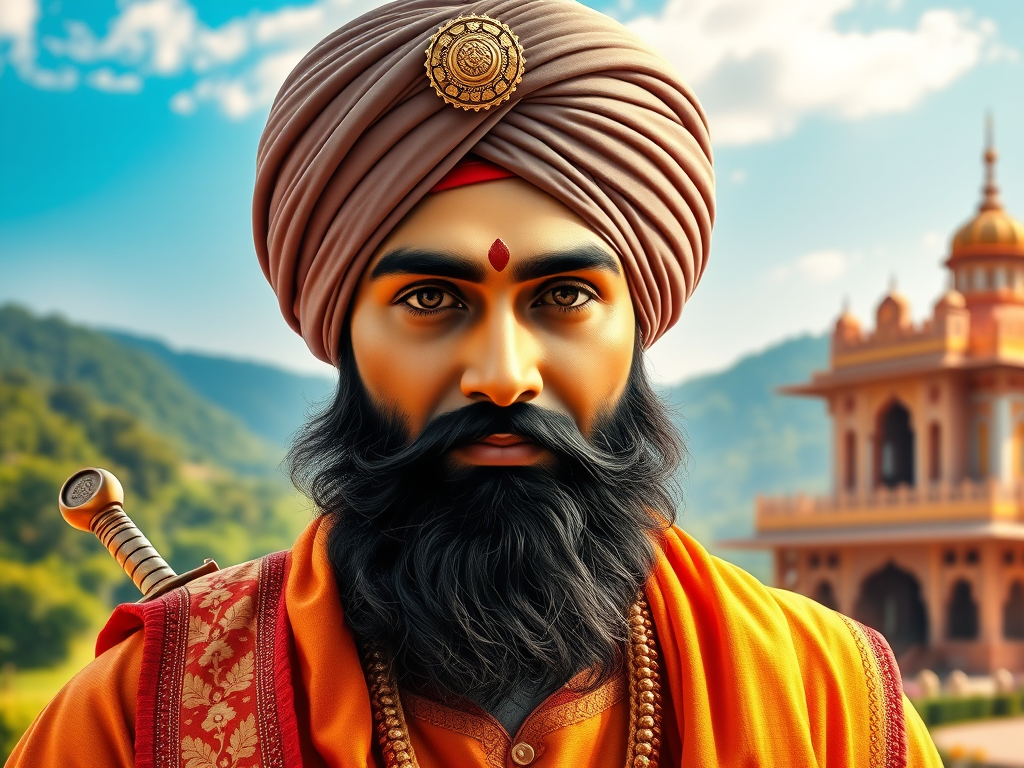
Bhakti, Sufism & Culture
3 resourcesThe Guru Gobind Singh resource opens an illustration, not an explanatory article. Browse all free study materials.
10 Original Medieval History MCQs
Attempt all questions before checking your answers. The explanations identify the concept behind each correct option. These are original practice questions, not claimed previous-year questions.
Frequently Asked Questions
What is the period of medieval Indian history?
For general-studies preparation, roughly the eighth to the eighteenth century is a useful broad convention. Academic periodisation varies, and the later centuries overlap with early-modern history.
Which five dynasties ruled the Delhi Sultanate?
Mamluk or Slave (1206–1290), Khalji (1290–1320), Tughlaq (1320–1414), Sayyid (1414–1451) and Lodi (1451–1526).
Who founded the Vijayanagara Empire?
Its foundation in 1336 is traditionally associated with Harihara I and Bukka I. Vijayanagara’s celebrated capital was at present-day Hampi.
What is the difference between mansab and jagir?
Mansab was a rank in the Mughal imperial service. A jagir was an assignment of revenue often used to remunerate imperial officials. They referred to different aspects of imperial organisation.
Is the Sikh Empire part of medieval Indian history?
The Sikh religious tradition and later political developments began in periods commonly treated as medieval or early-modern. Ranjit Singh’s Sikh Empire belongs principally to the early nineteenth century and is included here for continuity.
Are the practice questions actual UPSC previous-year questions?
No. The self-test below contains original revision questions, not questions represented as official UPSC or BPSC previous-year papers.
Further Reading and Primary Reference Points
Consult NCERT: Our Pasts–II (History) for foundational textbook chapters, including Delhi and the Mughals; the UNESCO World Heritage Centre’s Hampi entry for the city’s architecture and historical significance; and the official syllabus and previous papers issued by your examination authority. The chapter summaries here are original exam-oriented explanations, not replacements for reading historical evidence.