
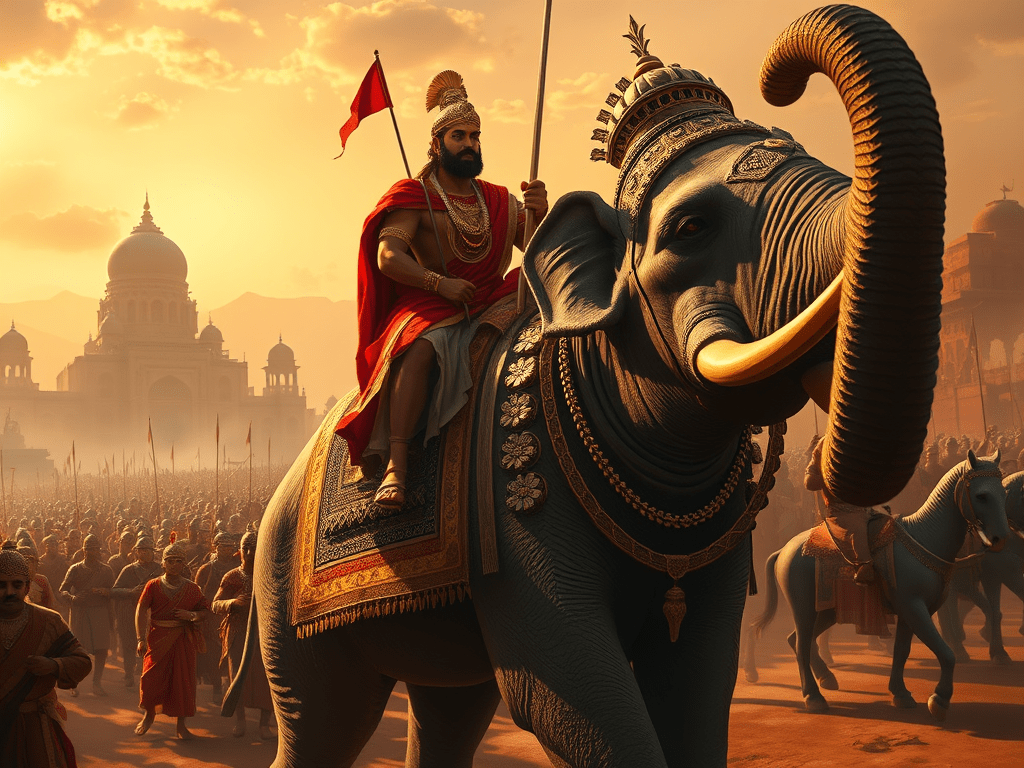
Chandragupta Maurya was the founder of the Mauryan Empire, one of the largest and most influential empires in ancient Indian history. Rising from humble origins, he overthrew the Nanda Dynasty with the guidance of his mentor Chanakya (Kautilya) and established a centralized empire that unified much of the Indian subcontinent. Centered in Pataliputra (modern Patna, Bihar), Chandragupta’s reign (c. 321–297 BCE) marked the transition from the Mahajanapada period to imperial India, characterized by military conquests, diplomatic alliances, and administrative innovations. This study material explores Chandragupta’s life, achievements, administration, and legacy within the context of the Mauryan Empire, with a focus on his role as its founder.
1. Historical and Geographical Context
Chandragupta Maurya emerged during the late 4th century BCE, a period of political upheaval following the Nanda Dynasty’s dominance and Alexander the Great’s invasion of northwest India (326 BCE). The power vacuum in the northwest and discontent with Nanda rule provided an opportunity for Chandragupta to seize control of Magadha, the most powerful Mahajanapada.
Key Features:
- Geography: The Mauryan Empire under Chandragupta spanned modern-day northern India, parts of eastern Afghanistan, Pakistan, and extended southward to central India, with Pataliputra as the capital.
- Timeline: Chandragupta’s reign, c. 321–297 BCE, marked the foundation of the Mauryan Empire, which lasted until c. 185 BCE.
- Significance: Chandragupta’s conquests and administrative reforms unified diverse regions, setting the stage for the empire’s zenith under his grandson Ashoka.
2. Origins and Sources
Chandragupta’s early life is shrouded in legend, with varied accounts from Indian and Greco-Roman sources:
- Buddhist Texts (Mahavamsa, Dipavamsa): Describe Chandragupta as a Kshatriya from the Moriya clan, possibly linked to the Shakyas (Buddha’s clan), born in Magadha.
- Jain Texts (Parishishtaparvan): Claim he was raised by a peacock-tamer’s family, with humble origins, and mentored by Chanakya.
- Puranas (Vishnu Purana): Suggest he was of low birth, possibly a Shudra or Vaishya, or an illegitimate Nanda heir.
- Greek Accounts (Strabo, Justin): Refer to Chandragupta as Sandrocottus, a young adventurer who rose from obscurity to challenge Alexander’s successors and the Nandas.
- Archaeological Evidence: Limited for Chandragupta’s reign, but Pataliputra’s excavations (e.g., wooden palisades, Northern Black Polished Ware) confirm urban growth.
The consensus is that Chandragupta was likely of non-elite origins, trained by Chanakya, a Brahmin scholar, who saw in him the potential to overthrow the Nandas and unify India.
3. Rise to Power
a) Overthrow of the Nanda Dynasty (c. 321 BCE)
- Context: The Nanda Dynasty, under Dhana Nanda, was unpopular due to heavy taxation and autocratic rule. Magadha’s vast resources made it a prime target for Chandragupta’s ambitions.
- Chanakya’s Role: A brilliant strategist, Chanakya (author of the Arthashastra) mentored Chandragupta, training him in governance, warfare, and diplomacy at Taxila. After an initial failed rebellion, they devised a strategy to weaken the Nandas from the periphery.
- Campaign: Chandragupta mobilized a coalition of disaffected nobles, Kshatriyas, and tribal groups, starting with northwest conquests (possibly Punjab). He gradually encircled Magadha, capturing Pataliputra c. 321 BCE, deposing Dhana Nanda.
- Outcome: Chandragupta inherited the Nanda treasury and military, providing a foundation for his empire.
b) Conflict with Alexander’s Successors
- Seleucid Challenge: After Alexander’s death (323 BCE), his general Seleucus I Nicator sought to reclaim northwest India. Chandragupta confronted Seleucid forces in the Seleucid-Mauryan War (c. 305–303 BCE).
- Treaty of the Indus: Chandragupta secured a diplomatic victory, ceding marginal territories (parts of Gandhara, Arachosia) to Seleucus in exchange for:
- 500 war elephants, bolstering his military.
- A marriage alliance, possibly with a Seleucid princess.
- Control over eastern territories, consolidating his empire.
- Significance: The treaty established peaceful relations with the Hellenistic world, fostering trade and cultural exchange.
4. Achievements and Administration
Chandragupta’s reign was marked by territorial expansion, administrative reforms, and economic prosperity, establishing the Mauryan Empire as a model of centralized governance.
a) Territorial Expansion
- Northwest India: Consolidated control over Punjab, Gandhara, and parts of modern Afghanistan, reclaiming regions vacated by Alexander’s successors.
- Central and Southern India: Extended Mauryan influence into modern-day Gujarat, Maharashtra, and possibly Karnataka, subduing regional chieftains.
- Eastern and Northern India: Inherited Magadha’s dominance over the Gangetic plains, including Kashi, Kosala, and Vaishali, and possibly some parts of Bengal.
- Scope: By the end of his reign, the empire spanned from the Hindu Kush to central India, unifying diverse ethnic and cultural regions.
b) Administration
- Centralized Bureaucracy: Chandragupta implemented a hierarchical system, likely based on Chanakya’s Arthashastra:
- King: The emperor held supreme authority, advised by a council of ministers (mantriparishad).
- Provinces: The empire was divided into provinces (janapadas), governed by royal princes (kumaras) or senior officials (mahamatras).
- Local Governance: Villages were managed by gramakas, with councils handling local affairs.
- Taxation: Collected land revenue (one-sixth to one-quarter of produce), trade tariffs, and urban levies, funding infrastructure and the military.
- Espionage: Maintained a network of spies (gudhapurushas) to monitor officials and prevent rebellions.
- Judiciary: Established courts with dharmasthiyas (civil judges) and kantakasodhanas (criminal courts) to enforce law and order.
- Infrastructure: Built roads, canals, and rest houses to facilitate trade and communication, with Pataliputra as the administrative hub.
c) Military Organization
- Standing Army: Maintained a large, professional army, including infantry, cavalry, chariots, and elephants (bolstered by the Seleucid treaty).
- Size: Greek sources estimate 600,000 infantry, 30,000 cavalry, and 9,000 elephants, though these figures may be exaggerated.
- Fortifications: Strengthened Pataliputra with wooden palisades and moats, as evidenced by archaeological finds.
- Strategy: Combined conquest with diplomacy, using marriage alliances and treaties to secure borders.
d) Diplomacy
- Seleucid Alliance: The treaty with Seleucus I ensured peace and trade with the Hellenistic world.
- Greek Ambassadors: Megasthenes, a Seleucid envoy, resided in Pataliputra, documenting Mauryan society in his Indica (fragments preserved in later Greek texts).
- Regional Alliances: Marriage alliances with local chieftains integrated diverse regions into the empire.
5. Social and Economic Structure
Chandragupta’s empire reflected the social and economic dynamics of the post-Mahajanapada period, with a blend of Vedic and urban influences.
a) Social Structure
- Varna System: The fourfold hierarchy (Brahmins, Kshatriyas, Vaishyas, Shudras) persisted, with Chandragupta’s ambiguous origins challenging Kshatriya norms.
- Brahmins: Served as advisors, priests, and educators, benefiting from royal grants.
- Kshatriyas: Included military elites and provincial governors.
- Vaishyas: Engaged in agriculture, trade, and commerce, forming the economic backbone.
- Shudras: Performed labor, with some mobility in urban centers.
- Jati (Caste): Occupational groups solidified, with shrenis (guilds) organizing artisans and traders.
- Urban Elite: Pataliputra’s shreshthins (merchants) and bureaucrats formed a new class.
- Women’s Status: Largely domestic, though elite women influenced diplomacy (e.g., Seleucid marriage). Jain texts mention women ascetics.
b) Economy
- Agriculture: The fertile Gangetic plains produced surplus rice, wheat, and barley, supported by state-sponsored irrigation and iron tools.
- Trade: Controlled key routes, including the Uttarapatha (northwest) and Dakshinapatha (south), trading textiles, spices, and gems with Persia, Central Asia, and the Hellenistic world.
- Currency: Punch-marked coins (silver and copper) standardized commerce.
- Urbanization: Pataliputra was a cosmopolitan metropolis with palaces, markets, and fortifications. Other cities like Taxila and Ujjain thrived as regional centers.
- State Control: Monopolies on mines, forests, and salt, as per the Arthashastra, boosted revenue.
6. Cultural and Religious Contributions
Chandragupta’s reign fostered a pluralistic cultural environment, with significant religious developments.
a) Religious Patronage
- Jainism: Chandragupta is said to have embraced Jainism in his later years, influenced by the monk Bhadrabahu. Jain texts claim he abdicated, became an ascetic, and died at Shravanabelagola (Karnataka) c. 297 BCE.
- Buddhism: Supported Buddhist monks, though less prominently than his grandson Ashoka.
- Vedic Religion: Patronized Brahmins and Vedic rituals to legitimize his rule, maintaining balance among faiths.
- Syncretism: Encouraged coexistence of Vedic, Buddhist, and Jain traditions, reflecting Magadha’s diversity.
b) Intellectual Developments
- Chanakya’s Arthashastra: This treatise on statecraft, economics, and warfare, attributed to Chanakya, reflects Mauryan administrative practices.
- Pataliputra as a Hub: Attracted scholars, fostering debates on philosophy and governance.
- Greek Influence: Megasthenes’ Indica documents Mauryan society, indicating cross-cultural exchanges.
c) Art and Architecture
- Limited surviving evidence, but early Mauryan architecture included wooden palaces and fortifications in Pataliputra.
- Stupas and monasteries began to emerge, laying the groundwork for Ashokan pillars and rock edicts.
7. Later Life and Abdication
- Jain Tradition: According to Jain texts, Chandragupta, influenced by Bhadrabahu, abdicated c. 297 BCE, handing the throne to his son Bindusara. He migrated to Shravanabelagola, practicing sallekhana (ritual fasting) until his death.
- Buddhist Accounts: Less detailed, but confirm his abdication and Bindusara’s succession.
- Legacy: His abdication reflects the influence of Jain asceticism and his commitment to spiritual ideals, contrasting with his earlier militaristic career.
8. Legacy
a) Political Legacy
- Empire Foundation: Chandragupta unified India, creating a centralized empire that endured for over a century.
- Administrative Model: His bureaucracy, taxation, and espionage systems influenced later Indian statecraft, as seen in the Arthashastra.
- Pataliputra: Established as India’s political capital, thriving under Bindusara and Ashoka.
b) Cultural Legacy
- Religious Pluralism: His patronage of Jainism, Buddhism, and Vedic traditions set a precedent for Mauryan tolerance.
- Global Connections: The Seleucid treaty and Megasthenes’ embassy fostered India’s integration into Hellenistic trade and diplomacy.
- Jainism’s Spread: His asceticism popularized Jainism in southern India.
c) Historical Significance
- Chandragupta’s rise from obscurity to emperor highlights social mobility in ancient India.
- His empire bridged the Mahajanapada period and the classical age, shaping India’s political and cultural trajectory.
9. Challenges in Studying Chandragupta
- Textual Bias: Buddhist, Jain, and Puranic sources reflect religious agendas, with conflicting accounts of his origins.
- Greek Sources: Provide external perspectives (e.g., Megasthenes) but are fragmented and secondhand.
- Archaeological Gaps: Few direct remains from Chandragupta’s reign, with Pataliputra’s early layers obscured by later structures.
- Legend vs. History: Jain accounts of his abdication and death are hagiographic, requiring critical analysis.
10. Suggested Further Reading
- Primary Sources:
- Mahavamsa, Dipavamsa (Buddhist texts).
- Parishishtaparvan (Jain text).
- Arthashastra by Kautilya.
- Indica fragments by Megasthenes (via Strabo, Arrian).
- Secondary Sources:
- A History of Ancient and Early Medieval India by Upinder Singh.
- The Age of the Nandas and Mauryas by K.A. Nilakanta Sastri.
- Asoka and the Decline of the Mauryas by Romila Thapar.
- Online Resources:
- JSTOR for ancient Indian history articles.
- Archaeological Survey of India (ASI) reports on Pataliputra.
11. Conclusion
Chandragupta Maurya was a visionary leader who transformed ancient India by founding the Mauryan Empire. His overthrow of the Nandas, conquests across the subcontinent, and diplomatic triumphs, such as the Seleucid treaty, established Magadha as a superpower. Guided by Chanakya, Chandragupta’s administrative reforms and centralized governance created a model for imperial rule, while his patronage of Jainism and other faiths enriched India’s cultural landscape. His abdication and ascetic death reflect a remarkable journey from warrior to sage. Chandragupta’s legacy as the architect of India’s first great empire endures, shaping the subcontinent’s political and cultural history for centuries.


Leave a reply to बिहार, ओडिशा, बंगाल और असम के महत्वपूर्ण शासक एवं उनके उल्लेखनीय कार्य – cracktarget Cancel reply